

Unpopular Opinion: Megyn Kelly Was Right
In partial defense of Megyn Kelly's stupid-ass statement about 15-year-olds not being 8-year-olds.

Hello lovelies! Today is an aberration.
While the majority of the past year-plus that Another Jane Pratt Thing has existed (thank you all for the fun fun year!), in this spot I've written mostly introductions about the stories to follow, along with my own little life updates. (Speaking of which, I walked the red carpet with Michael the other night unannounced and got identified here as “guest”. I’m showing it off to you because I love that - truly - as much as having my head cropped out of paparazzi photos. I actually REALLY like being called “friend,” because it is a label I pride myself on having earned, but as I think about it now, whoever is writing the captions doesn’t ever know our relationship well enough to say that. So “guest” makes political sense.)

Anyway, then generally after my little intro here, someone else writes the main story below. But today I'm branching out from my usual italics to present to you something I wrote in Roman! You'll see the history of it at the top of the story and please talk to me more about that in the comments and also about random things. I don't even care if you read the words I wrote below or not (it’s a little long too and could use some of my own editing - show me your edit suggestions if you like please!). Just come to the comments and let's talk there about whatever is going on in your life also. I'll leave this post free to everyone so that you don't even have to pay to get in those comments. (I remember in one of my early Substack publishers’ Q and A sessions being asked why anyone would want to have people in their comments that hadn't read the stories. Which reveals a fundamental difference in the way I think of and LOVE our freewheeling comments sections.) So type away about anything there and I will too…
Love love love,
Jane
PS The premise for this piece, which I came up with about a month ago, was rejected (intelligently and understandably) somewhere else because of its controversial nature. I would love to hear what you think about that in the comments too. (PS It’s the story of my career.)
IN DEFENSE OF PART OF MEGYN KELLY’S STUPID STATEMENT THAT 15-YEAR-OLDS ARE NOT 8-YEAR-OLDS WHEN IT COMES TO SEX
By Jane Pratt
It’s taken me a while to get this up here because I originally was writing it for another publication. Not that I prioritize other publications over this one, OF COURSE NOT, but because the publication that I’m talking about is incredible and I respect them and publishing there would allow me to introduce a lot more people to our AJPT shenanigans and crew. So that was the goal. Plus they asked me.
So even though it now feels like three news cycles and ten trillion TikTok eons ago, I still haven’t heard this said, so here goes:
Megyn Kelly’s stupid-ass statement that a 15-year-old is not the same as an 8-year-old when it comes to pedophilia got the backlash it deserved from all over (even Casey Anthony weighed in - huh?!?). It seemed like one of those cultural phenomena that every single person felt compelled to make a public statement against and good because it absolutely should have been called out and condemned as widely as possible.
However, there’s an element of what Megyn said that has still been overlooked and that is this: It is not about comparing someone “barely legal”, as she grossly described Jeffrey Epstein’s typical teenage victim, to younger children in terms of crime or culpability or heinousness or anything else. Instead, her statement raises a point that I think warrants all of us grasping: the particular horror and damage that can be done to a 15-year-old in specific when seduced by someone old.
After Jeffrey Epstein was finally arrested in New York, most days I would walk past his townhouse on 71st St. (I don’t even live in the area, but I wanted to see), passing Howard Lutnick’s place next door and being tempted to steal his newspapers just for the humor and framing potential of having a New York Times or NY Post with his name and address on the mailing label. But I didn’t, because I am law abiding. Unlike... oh, I digress.

So I would walk past the news crews gathered outside, get close enough to see where the police had bashed the wooden front door in, and continue down the half a block to Central Park at the time of day that the schoolgirls were getting out of classes for the afternoon.
I would observe them and think about how these were just like the girls that Ghislaine and others would pick up for JE (the initials prominently displayed in gold letters on the front of his house until long after he was dead and the place was up for sale - good move, realtor). This was the same path where JE’s people would find schoolgirls to bring back to his lair. (I’m sure you’ve seen pictures of it, but many news sources called it a lair and it did it looked lair-like - and dungeon-like and castle-like at the same time. It definitely did not look easy to escape from.) What I saw in these girls was what I have seen in 15-year-old girls ever since I was one and had the most traumatic year of my life, which led me to be in some ways emotionally stuck at 15 and always able to relate most to others at that age.
Fifteen-year-old girls are also, not coincidentally, the exact demographic I studied the most when I started Sassy magazine and then continued to think about and get to know for the near decade I worked on it. During those years in the late ‘80s and early ‘90s (it’s always weird to me when people talk about Sassy as being a product of the ‘90s when our strongest issues and most statement-making statements came out in the ‘80s, but however people want to place it is fine and thanks for remembering it at all), I put a lot of effort into understanding and then conveying how teenagers were not the little kids that parents and teachers and other magazines at the time treated them like they were. They were wiser and more thoughtful than they were getting credit for. They were far more nuanced than the caricatures of them in pop culture. They could care about their zits and global politics at the same time. They wanted to be seen as having the maturity and depth and complexity that they knew they had inside.
Teenage girls also had sexual desires of their own. They knew that while the press suggested it was strictly boys who wanted sex and girls’ job to prevent them from getting it – or to give it away in exchange for something else valuable like popularity - that wasn’t the way they felt. This made the whole issue and potential act of sex way more complicated for them, with way more potential for guilt or shame than if they simply saw themselves as victims of others’ desires and their virginity as something to guard or trade. They/we were also figuring out what and who those biological sexual urges would attach themselves to.
The morning after my friend was gang-raped at 13, my inner dialogue was:
“Damn, Christy got to lose her virginity before I did! Get with it, Jane!”
And it’s for all these reasons that men and women who hit on 15-year-old girls, and may be excusing their behavior by viewing them the way that Megyn Kelly described - as “barely legal” - are creating a specific kind of trauma. It’s a trauma that we have learned again recently with Virginia Giufree’s suicide will never go away. It will impact every aspect of their lives and how they raise their daughters or whether they have daughters at all. There will not be a day after even what might be considered a subtle flirtation by an older man or woman that this will not affect them. They will remember it and live or die with it forever.
There have been studies of survivors of sexual abuse that back this up, such as this most comprehensive one from 2013 on the psychological effects and behaviors of three generations of female survivors. Their results point to all of the detrimental and devastating outcomes of early sexual abuse, from increased addictive behaviors to risky sex to self harm and on and on. The study covers victims from ages 11 to 25 but doesn’t separate out among them by age in their presentation of the findings, though I would really like to see that myself for the purposes of this Unpopular Opinion. There seems to be a lot more research on the effects of sexual abuse on younger children, which tracks with what Megyn Kelly’s argument was - that the most heinous offenses involve the youngest victims.
There was a more recent British study of teenagers whose findings’ overview helpfully explains: “Teenagers who have been sexually assaulted are at risk of mental health conditions and poor school performance, research found. The increased risk lasted for more than a year…. This is also the time when mental health problems often start, and when young people take key exams and make decisions about university. However, little is known about the lasting impact of assault on teenagers’ mental health and education.” The report concludes with a section called “Why Is This Important?” !!!!!???!!!. Can I please repeat that again? “WHY IS THIS IMPORTANT?!?!?!?!?!??“ And then they tie the sex abuse to the “bigger issue” of how it affects education. The idea that teenagers’ mental well-being isn’t enough of a reason to care doesn’t surprise me, unfortunately. These are teenagers we are talking about and they are often treated as less in need of attention and help of all kinds than their younger counterparts.
“An abundance of professionals in the field of child sexual abuse are more skeptical of adolescent claims of abuse,” says a survey.
Seriously fuck that abundance of “professionals.”
When you go searching for information on teen sexual abuse by older men and women, what else pops up are ads from law firms that specialize in teen sex assault cases. Aside from their explanations as to why it is more difficult to win a case if the victim is a teen versus a younger child, the majority of the ads are for lawyers who represent the “victims” who have been accused by teenagers of sexual abuse, rather than the other way around. They cite reports on “Why Adolescents Lie,” with summaries like this egregiously slanted one from a law firm I won’t even link to here because they don’t deserve the clicks (and these study links within are theirs, not mine):
“The tendency to buck authority as a teen is no secret to anybody…. One way to shift the power dynamic is through lying about abuse…. Adolescents are more susceptible to lying than younger children. According to expert studies, adolescents deceive because they’re seeking some form of freedom. Often, their deception is an attempt to escape punishment for misbehavior. Or they’re trying to accomplish something that’s been forbidden. For adolescents, lying is the most direct pathway to escape discipline or to experience an adventure that has been disallowed.”
It continues: “We previously discussed the lack of comprehending the consequences of these lies. When you combine that issue with the psychological causes of adolescent lying, one can assume it increases the chances of false accusations. It’s in an adolescent’s nature to make harmful decisions. In fact, an abundance of professionals in the field of child sexual abuse are more skeptical of adolescent claims of abuse than available research suggests is required.”
Well, there is a special place in hell for those lawyers and anyone who worked on those ad campaigns for perpetuating those incredibly devastating false stereotypes, along with of course predators like JE AND dingbats like Megyn Kelly, who refuse to see teenage girls for all that they really are and our need to protect them by calling these perpetrators what they are and condemning them fully for it. The teenage victims are not “barely legal” and the predators are not “sugar daddies”, “dirty old men,” “creepers,” “leches,” etc, etc., gross etc. Of course“pedophiles” is just one of many fitting descriptions. But the point is not just that they are so close to being eight or even ten, which we’ve been hearing a lot about - and seeing in all the social images posted by users of themselves at the age of 15 - and is of course true. The point is also that they are not. They are exactly teenagers. Teenage girls specifically. And that’s what’s so harmful.
The last people any of us would’ve considered talking to about what happened that night were our parents. Second last would have been teachers, doctors, counselors (we didn’t have many of them back then anyway)…
Being 15 is one of the most confusing times in life. For girls especially. Regarding sex, especially. Preying on them versus younger kids is not necessarily a lesser crime or a greater crime. But it’s a crime whose recent attention puts me in the position again, almost 40 years after starting Sassy magazine, of pointing out that 15-year-old girls are very different than they are still generally perceived to be. And in many ways, the most vulnerable of all.
.
When I say 15, I’m talking about a very specific time in a girl’s life that sometimes she hits slightly before that age or sometimes slightly later and it’s a phase that doesn’t last long. When starting Sassy, there was constant interest from my advertising sales people in having me expand the reach of our editorial to bring in readers both younger and older in order to appeal to the advertisers who were targeting them. The most I would stretch was to gear it toward the range of 14- to 19-year-olds because even the inner and outer life of a 14-year-old and a 19-year-old are vastly different. Whenever we got reports on our reader demographics, there was always a spike right at 15. Not a median or a mean, but the other one that means a larger number of 15-year-olds over any other age. It is this one specific stage that is particularly vulnerable on the inside and impervious-seeming on the outside that I’m talking about.
When I was 13 years old, my same-age friend Christy (I changed her name) went to a party that was a common type to us at that time. A bunch of teenagers in a rural area of Durham, North Carolina would meet up in a field somewhere with our driving friends’ headlights facing inward in a circle to drink and blast music and sometimes smoke what we called pot. I didn’t get to go to that specific night’s party for some reason I can’t quite remember. Maybe I couldn’t get a ride.
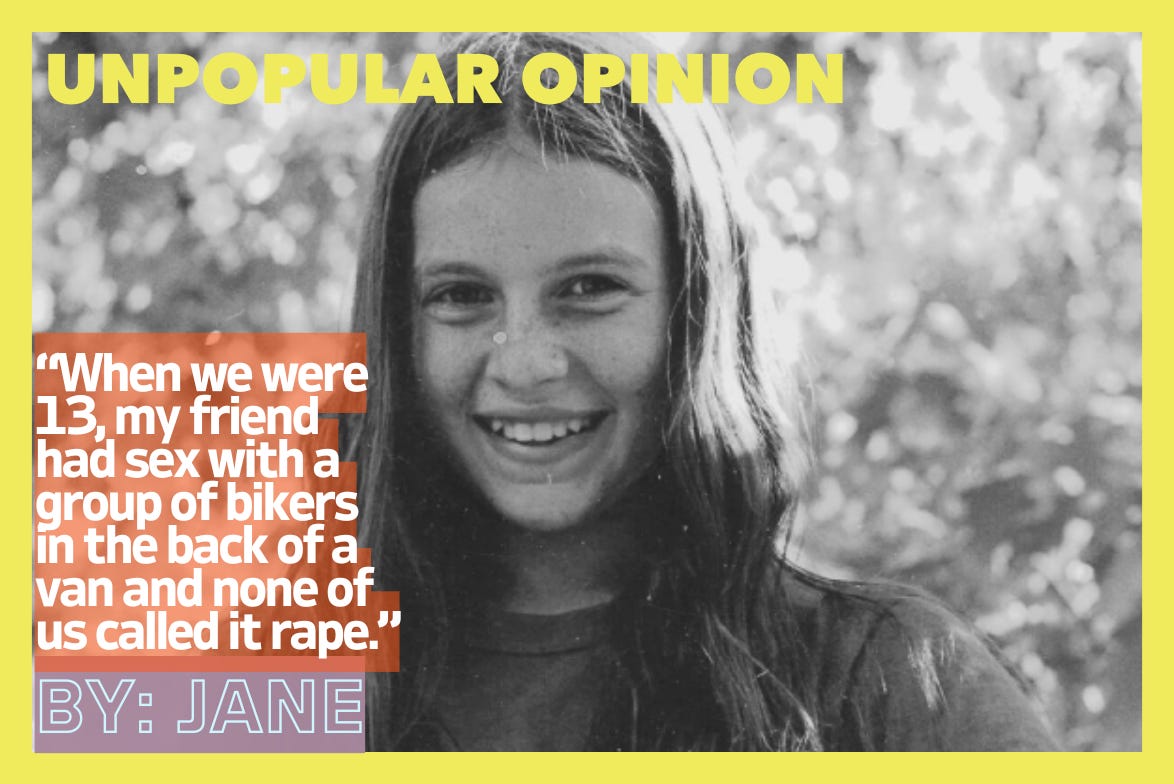
But the next day at school, Christy and some of the other attendees told us how she had lost her virginity that night to a group of Hells’ Angels guys in the back of a van there. None of us called it rape, and that's not how we thought of it until years and years later. My inner and outer dialogue around it was “Damn, Christy got to lose her virginity before I did! Lucky! Get with it, Jane!”
The absolute last people Christy or any of us would’ve considered talking to about what happened were our parents. Second last would have been teachers, doctors, counselors (we didn’t have many of them back then anyway) or any authority figures at all. And that illustrates the other particular hazard for teenage girls when things happen to them. Who do you go to besides each other? So it becomes this female Lord Of The Flies-like situation (or in rarer cases, a more supportive version - which is part of what Sassy magazine was constantly trying to foster) where you together are determining the rules. And in this case, we ruled that this was a triumphant moment, something to be proud of if you were Christy or envious of as Christy’s close friends. None of us told anyone besides each other. Game on.
My friend Cindy (real name) and I were 16 when we determined we would lose our virginity ASAP. We wanted to get rid of those albatrosses and it didn’t matter (we thought) who we lost it to, just that we did. She won. I was 17 when I finally caught up, thank god.
I’m not still in touch with Christy so I can only imagine how that night down in North Carolina has affected her with more adult perspective to see what happened to her for what it actually was. Or to see those men for who they actually were. Or to even understand how other aspects of her life after that were affected by it. But I do know that the effect on me and Christy and the rest of that friend group at the time was to further numb us to the idea that we were in fact, vulnerable and just five years past being 10 and 10 years past being 5 and still children in many ways. We went on. We took care of ourselves.
I hope that something in that story (or something unrelated to that story) inspires you to click the button below and leave a comment, because I would love to talk to you - especially now. Thanks and love.
I was 16 when I was raped, but I had been pulled out of school because of what would take 2 years to be determined to be panic disorder. It was disorienting, as I was naive, a virgin, and in that stereotypical guilt because I’d had a crush on my rapist. Before he was a rapist, he was my brothers fraternity brother. I saw myself as a child, and him, at 24, safe to worship.
The night I was raised my brother had a party to introduce his frat brothers to his high school friends (feel free to gag). My parents blinded by this golden boy thought this a great idea, and left for the night. Kegs, liquor, what could go wrong? I hid in my room, listening to The Replacements - Don’t Tell a Soul on repeat. I didn’t like the rowdy drunk crowd, and I wasn’t in a good place. Hours passed until my now sister-in-law banged on my locked door til I opened it, dragging me downstairs. Have some juice. Have some juice and you can go back to your room.
I had the juice. It was a Kamikaze shot. I panicked. I went outside to clear my head, practicing my new smoking habit I’d taken up to numb myself. Suddenly, I wasn’t alone. He was there. He wanted to walk. He didn’t want me to smoke. Smoking is disgusting (likely why I’d keep the habit 30 more years until I got lung cancer). My mind wasn’t clear from the shot and I thought he was trying to help me. He took me behind my dad’s little red barn. He told me how much I wanted this. Then kissed me, and pushed me down into the mud, until mud filled my mouth. I had no idea what was happening. Not even the mechanics. I was still too afraid to try tampons. But I focused on being able to breathe, because his forearm was on my head pushing it in wet fall mud. And the whole time he told me how much I wanted this. Wanted him. And I died inside, believing I had inadvertently done this to myself.
When over, he stumbled away. I went into panic mode. I addressed the scene - he’d left his shoes. I picked up my torn clothes, and waited to make a break for getting back to my room without being seen.
Later, my brother would come to my room as I hid evidence under my blankets. He knew we had both been missing. I saw his disappointment, confusion, as he reached and took a muddy leaf from my hair.
The next morning I got up to tell what had happened. There were hungover people everywhere, my dad was feeding them pancakes. I went back to my room.
I had a friend take me to planned parenthood. There was a lot of damage. We called it sex too. Lost my virginity.
A month later I wrote my brother a letter. He read it. Never said a word.
Bulletpoints:
The frat said they were going to punish him, kick him out, it was a lie. His punishment was he had to tell his girlfriend - now wife - he had cheated on her. My brother would tell me he didn’t believe forced was involved. This has kept us estranged for 36 years. His proof? He asked the man if he raped me-and he said “I can’t remember. I was too drunk.”
So, I was a liar. I went to a lawyer, he said I was a liar. Even with my medical report. Even though it was statutory rape. He refused to take the case to save my family the embarrassment.
This was what it was like in 1989. I’m just lucky had Sassy. Because it was the only thing telling me I wasn’t a liar. But teen years are confusing as fuck, and adults that take advantage of those teens should be punished.
Instead, I spent decades being called a slut by that frat and the girlfriends (his and my sister-in-law’s) sorority. Because I had hurt their “sister” by sleeping with her boyfriend.
The world is a terrifying place at present, and I’m most grateful I’m not a teen… but everywhere I see these people. The JE’s… but also those that support them.
They are everywhere.
Sorry for long comment.
I'm moved by and sending my hugest gratitude to the reader who just paid to subscribe while reading this post even though it was not required in order to finish reading it or to comment. You rule and I will make it worth every penny. The regular writers and I THANK YOU!