

Unpopular Opinion: Stop Treating Public Places Like Your Living Room
The pandemic didn’t just blur the line between private and public life. It taught us to stop seeing each other as real. PLUS: Jane's farts.
Well, hell-OHHH! That’s my imitation of the inimitable Charlie, my partner in crime since pre-day-one here at AJPT, and I just heard it in my head as I was writing this because it’s so welcoming and warm when he says it and I feel particularly welcoming and warm toward you today. And needy, so keep that in mind by talking to me as much as you like about anything at all in the comments, thank you!
So. We could safely preface every thought these days with: There are bigger problems in the world. There are some of the biggest problems ever in the world, if you care about life and death and every single critical issue. Now having acknowledged that, I will say that in addition, I have been noticing something perturbing lately and it actually relates to this wonderful piece from Leslie today (unlike my usual unrelated intros that at least Rachel Kramer Bussel appreciates - thanks, Rachel!).
Here's the thing I'm noticing: More and more people not using their headphones, earphones, airpods, whatever, and instead just talking on speaker to whoever they’re (usually loudly) talking to about whatever they want to talk about from wherever they happen to be. Maybe they are concerned about EMFs, as I am which is why I won’t do the airpods personally, or maybe it’s a civility shift. Though it happens everywhere, elevators seem to be a really popular spot for this to reach its full crescendo, at least here in NYC.
This morning (if noon qualifies), three separate individuals were talking high high volume into their phones for all 28 floors of one elevator ride I took. None seemed the least bit self-conscious about it. I was as usual working on my phone too but not out loud. (I used to be such the multi-tasker but more recently I prefer to focus on three things at once, rather than an infinite constantly-incoming number of things. I'm not sure when or why this transition happened, but it seems to coincide with the era when I started turning off the car radio in order to park - which some will claim is not an age-related trait, but I think might be.)
Anyway, this speaker phone yelling trend (which does hurt my productivity when I leave on my voice dictation and the microphone adds their dialogue into what I am writing here for you) is tied to Leslie's unpopular opinion today, which I really really like. I had never encountered Leslie before she pitched me some ideas at Jane@AnotherJanePrattThing.com and today’s story is where we ended up. What she did with the topic of these cultural changes, and what I learned from her theories about why this all is happening now, are fascinating to me and unexpected.
By the way: Another thing I heard (again) recently about aging is to smell your own farts because it helps ward off dementia. There is some dispute over how effective this method is, but a study on it popped up in the news again and I’ve been all in ever since. Why not? It’s easy to incorporate into your regular routine. I’ve even extrapolated from their research to theorize that biologically we may be prone to producing more gas as we get older because we need a higher dosage of dementia-prevention. Think about it. Or not. (They don’t say whether this works when smelling someone else’s farts, but there was a guy in front of me in line at CVS last night that could have reversed my Alzheimer’s risk exponentially. And he must be so sharp-minded himself!)
Last thing I will give you today before you get to the featured story, is based on a very thoughtful email from an unsubscriber explaining that he had loved what I did in New York magazine but didn’t find the stories here at AJPT to be relevant to him. Since what I did for NY mag, and for my old Sassy pal Andrea Linett’s Substack also, was product recommendations and tips, I am going to try out doing them here regularly on my own little site. I foist my weird recommendations (that actually work) onto my friends and family all the time, so why not share them with you? Well, the main reason I have held back from posting them here is because I didn't want you to think that the purpose of this site is for me to make you buy things, because it's really not (except a Sassy T-shirt because $ from that goes to the best causes.) But I’m going for it and that new feature will be featured on my next entry here and it’s a life-changing tip you won’t want to miss. Even more valuable than smelling your own farts.
I love and need you,
Jane
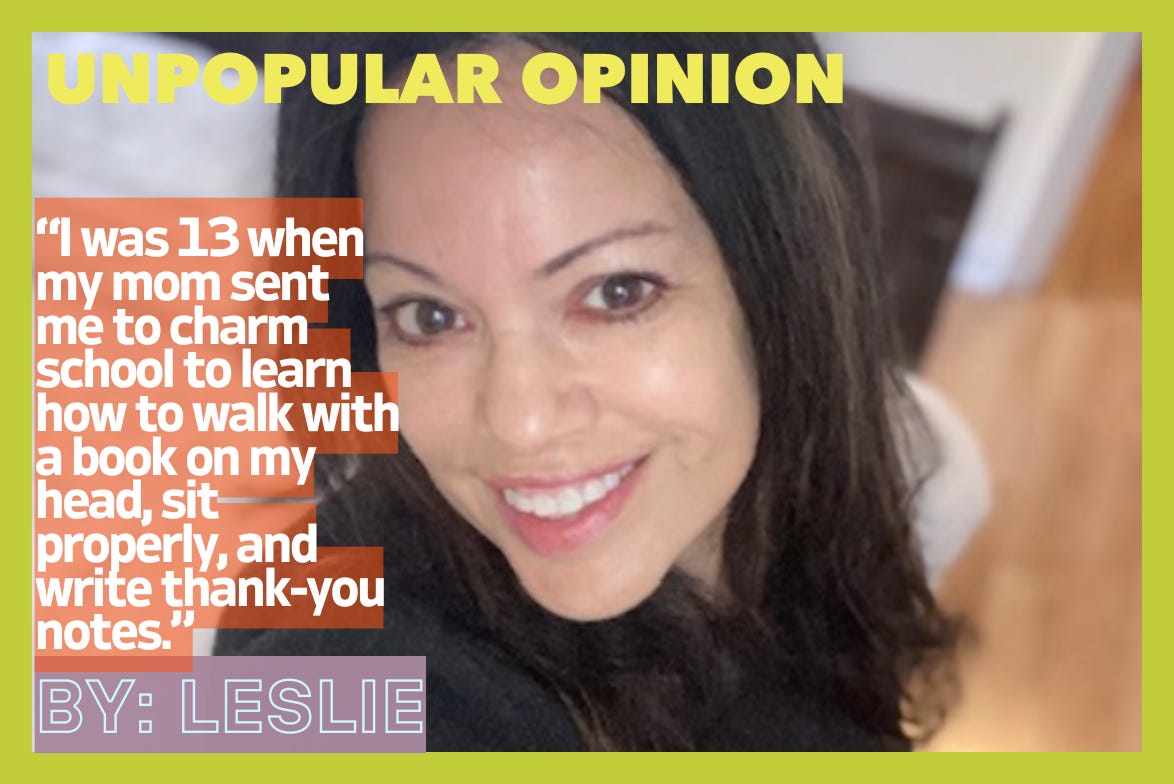
By Leslie Vooris
My mother once sent me to charm school for a reason that now feels almost radical: she wanted me to notice other people. I just didn’t realize it at the time. I thought it was just about her outdated way of thinking, that I was an awkward teen who was desperately in need to appear and seem more “graceful”. So, we decided to compromise. I was 13 and wanted to wear makeup, and she wanted me to learn how to walk with a book balanced on my head, sit properly, and write thank-you notes. The brochure that convinced me was printed on linen paper in soft shades of pink, the cursive writing faintly perfumed with the scent of Tea-Rose drugstore perfume. In exchange for lip gloss, I learned to make eye contact, to shake hands, and to behave as though the world did not revolve exclusively around me.
It all felt theatrical and mildly ridiculous. Now it feels like anthropological training for a civilization that no longer exists. Somewhere along the way, I noticed a shift, one that was accelerated by the pandemic but brewing long before it. I feel that collectively we decided that public space is just the overflow area of our personal lives. Trains became dining rooms, sidewalks became phone booths, gyms turned into snack lounges, and cafes became conference rooms. Wherever we land, we settle in like we’re “home”.
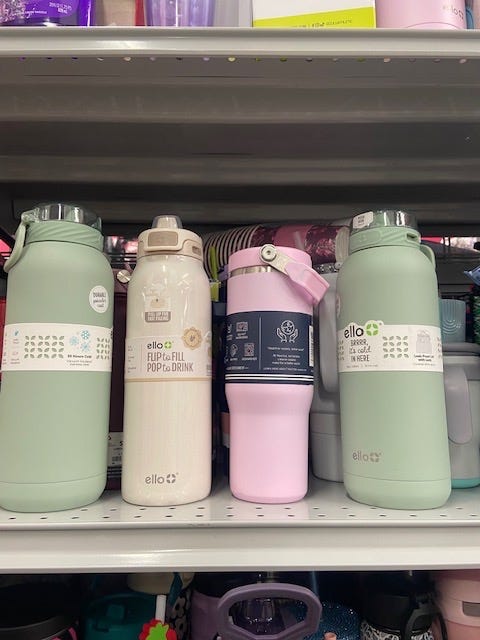
I have watched people eat full meals on buses and commuter trains like raccoons who’ve just discovered delivery apps, clutching giant emotional-support thermoses like life rafts as we slurp, unwrap, and settle in. I try to relax but cannot tune out the loud noises of someone munching in my ear. At coffee shops, I sit down with my laptop and headphones only to have someone plop next to me and take back-to-back Zoom calls as if they’re alone in their childhood bedroom. At the gym, I’ve seen people eat soup mid-workout and “reserve” equipment with enormous water bottles while scrolling through social media and filming themselves.
As I witnessed this more and more, I came to realize this behavior is not limited to just NYC where I live, it’s everywhere. And apart from general apathy towards others, it hints at something deeper.
During the pandemic, we spent so much time alone that we forgot what it meant to share space. Our homes became our offices, our classrooms, our gyms, our sanctuaries. Pants were optional. Background noise was normalized. Midnight snacks became breakfast. And when the world reopened, we brought our indoor habits with us, emotionally, logistically, and socially.
Only now, our living rooms are everywhere.
But something deeper happened than just a collapse of etiquette, as we became more accustomed to increasing levels of casualness, we inadvertently grew even more alone. The COVID isolation we all experienced disrupted our routines, but it also achieved something else; it eroded our sense of public life itself. We stopped building the social muscle required to exist among strangers. Other people became abstractions, faces on screens, usernames, voices through devices, until the physical presence of an actual human being became something to work around rather than with.
“This isn’t the same as feeling invisible, it’s even worse.”
When I walk through the world now it feels like stepping onto a surreal reality show where everyone is the main character and no one’s a neighbor. This isn’t the same as feeling invisible, it’s even worse, I have arrived at the conclusion and feel the eeriness that we aren’t real to one another at all. We have evolved to view others as mere obstacles, and as annoying inconveniences, as if we are all now background extras in each other’s story.
And it’s exhausting.
Some people tell me that I shouldn’t be so angry, and I tell them they are missing the point, I’m not angry (well, maybe just a little) - it’s that now I come home feeling hollow and empty. For me, public life used to offer a low-level feeling of connection, the reassurance of being among familiar strangers, the small comfort of eye contact, the choreography of politeness. It’s the reason I love being out in the world instead of cooped up in my apartment, it’s the reason I love cities, I in fact love being around other people. But now I feel like we move through each other rather than with each other.
Of course, main character culture didn’t come from nowhere, but social media rewarded it. And algorithms amplified it and then the pandemic supercharged it. We were taught that our lives were content, our emotions were branding, and our comfort was paramount. We learned that if something wasn’t immediately affirming or entertaining, it wasn’t worth tolerating.
Everywhere I look, I feel like I’m watching people focus on their supremely curated optimized performances. Our lives have become mostly just about us. We all get to be stars now, and we don’t even have to have scene partners.
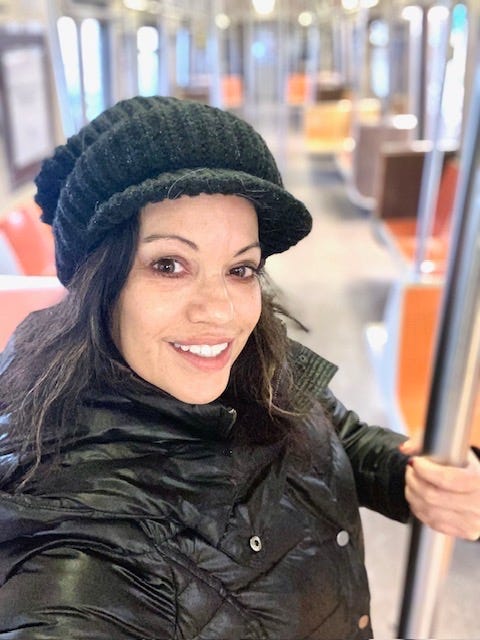
I’m not suggesting that we revert to a reality where we need to memorize which fork to use, digging out our grandmother’s etiquette pamphlets, and reading old columns on how to behave “like a lady” and when men are expected to always open doors….
I argue that manners were never about forks or formalities; they were how we acknowledged each other’s humanity. They were tiny gestures that said: I see you. I recognize you. I will make a little room for you here.
I believe that in the idea that public life only works when we accept that it is not our private kingdom, it’s the friction that lies within our ability to compromise. It is other people’s voices and smells and schedules and bodies brushing up against ours. And there is something about this human chaos that I find comforting, and at times dare I say, exciting….
Whenever I venture out in public now, I’m reminded that the world is indeed a far lonelier place and that makes me sad. I wish we all could stop acting like we’re ghosts occupying the same physical space but living in separate emotional realities. I want all of us to remember that despite our screens and our self-mythologies, we’re still here together and that we are all temporary. Let us not forget that in a hundred years, none of us will be around.
This crowded, fragile, inconvenient world is all we get.
We could at least act like we know it. ᐧ
"They were tiny gestures that said: I see you. I recognize you. I will make a little room for you here." YES! and Thank you! I was just thinking about this very same social (anti-social?) behavior the other day, when I had an entire conversation about cars with my Lyft driver, only to learn that he was ACTUALLY TALKING TO SOMEONE ELSE THROUGH HIS EARPHONES! It was so crazy, I just started laughing my head off when I finally figured it out. He must have thought that I was also talking to someone on my headphones (except I wasn't wearing any and I didn't have my phone out). I felt like I was in some sort of rom-com movie!
I have double downed on talking to every cashier and delivery person and anyone with whom I make eye contact. Yesterday at CVS, some awful cover of “Only Wanna Be with You,” and I looked at the Coke delivery guy and said, “Why’d they do Hootie like this? “
There was a brief moment of confusion — like why is this woman talking to me — and then a big ol grin. “Yeah, this can’t be Hootie.”